
Property Operations
A Vacant Unit Is Not the Same as an Abandoned Tenancy
Two July 7, 2026 Wisconsin Court of Appeals decisions put a practical question back on the operations desk: does a dark, delinquent unit have documented possession status, or only signs of possible vacancy? Here is a cautious handoff standard for access, exterior work, and escalation.
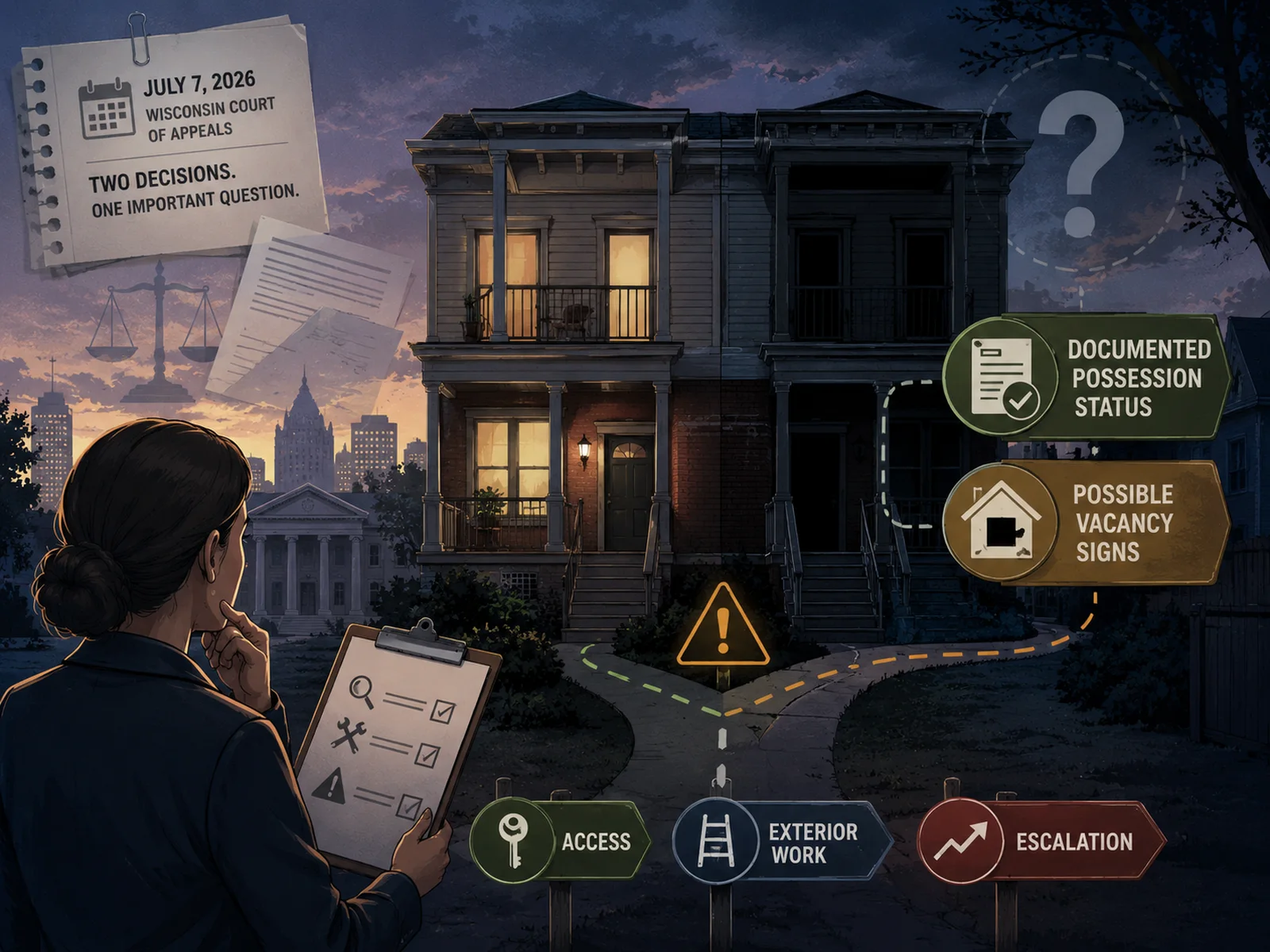
A vacant-looking unit can still be legally occupied
The operational pressure is familiar: rent is unpaid, lights are off, mail is accumulating, and the turnover calendar has started glaring at everyone in red.
But a unit that appears empty is not necessarily a unit an operator may treat as abandoned. That distinction matters before anyone changes access, removes property, starts a reset, or sends a vendor inside.
On July 7, 2026, the Wisconsin Court of Appeals issued two decisions arising from Milwaukee County involving the Housing Authority of the City of Milwaukee and Merrill Park. The landlords argued that the abandonment provisions helped mitigate losses after a tenant left. The tenants argued that the provisions allowed exclusion without judicial process. The court held that the clauses at issue violated Wisconsin law.
For portfolio operators, the useful lesson is narrower than a lease-law seminar: delinquency, visible absence, legal possession, and work authorization are separate status questions. A work order should not blur them together.
What the July 7 decisions held
In Housing Authority of the City of Milwaukee v. Party Sealed by Judge Morales-42 and Merrill Park v. Party Sealed, the Wisconsin Court of Appeals considered lease language that could allow management to deem a unit abandoned and exclude the tenant without judicial eviction procedures.
The court held that the provisions violated Wis. Stat. § 704.44(2m). It also held that including the prohibited language violated the statute even though the landlords had not used the clauses against the tenants in these cases.
The dispute was practical, not academic. An abandonment clause can look efficient when a resident is behind on rent and appears to be gone. In these two cases, however, the court concluded that the clauses could permit an exclusion without the required judicial process, rendering the written leases void and unenforceable.
Both opinions state that they will not be published, and each was decided by one judge. Operators should have Wisconsin counsel assess their precedential and citation effect rather than treating the decisions as an unqualified final statement for every abandonment dispute.
A dark unit, an unpaid ledger, or a need to relet may establish an operational problem. The decisions support treating those facts as different from documented authority to take possession. They do not establish that any specific observation is irrelevant or can never contribute to proof of abandonment.
What the decisions did not erase
The rulings did not make unpaid rent irrelevant.
The court held that the void written leases resulted in periodic tenancies for purposes of determining rent obligations. It remanded both cases for proceedings limited to calculating the appropriate amount of unpaid monthly rent, if any, and explaining any proven offsets.
Put plainly, invalid abandonment language may disrupt the written lease framework without automatically eliminating every potential rent claim.
That separation matters:
- Possession concerns whether management has a documented basis to take control of the unit.
- Rent recovery concerns what monthly rent was owed under the resulting periodic tenancy and what proven offsets apply.
- Mitigation and turnover planning concern what the organization does next within its documented authority.
These tracks may affect each other, but they should not become one decision. A delinquency report is not a possession order wearing a spreadsheet costume.
Use a unit-status ladder before assigning work
The decisions do not prescribe a portfolio workflow. The following ladder is an operating control derived from the risks they identify.
Terms such as “vacant,” “gone,” or “turn-ready” are efficient only until someone needs to explain who authorized entry and why.
1. Delinquent account
The resident has an unpaid balance or missed payment. This is an account status.
It does not itself establish that the resident moved, surrendered possession, or lost access rights.
2. Observed absence or suspected physical vacancy
Staff observations, attempted contacts, or exterior conditions suggest that the unit may be unoccupied. Record exactly what was observed, who observed it, and when.
Accumulated mail, a lack of visible activity, exterior conditions, or unsuccessful contact attempts may support escalation. Do not treat them as an automatic substitute for a documented basis to take possession.
3. Possible voluntary surrender
The file contains evidence that may indicate the resident voluntarily gave up the unit, such as a surrender record, returned keys, written notice, or other communication.
These are possible indicators, not a universal sufficiency test. The organization should use current Wisconsin legal and lease guidance to determine whether the full record establishes surrender.
4. Documented legal basis for possession
The file includes court-based authority or another basis for possession that the organization's current legal and operational review process has confirmed.
This status distinguishes a suspected physical vacancy from a possession decision supported by reviewed documentation. The court opinions do not define every lawful route to possession, so the file should identify the specific basis rather than relying on the word “abandoned.”
5. Confirmed work authorization
A named internal approver has released a defined scope, stated the access limits, and identified what the vendor may and may not do.
This step matters even after possession has been confirmed. A vendor needs an authorized scope, not an invitation to interpret tenancy law in a parking lot.
Require a handoff packet, not a hallway conclusion
For a delinquent unit that appears vacant, a portfolio can require a basic handoff packet before assigning access-dependent work. This is a proposed operating control, not a procedure imposed by the July 7 decisions.
Include:
- Account status and relevant dates.
- An observation log with dates, times, conditions, and the person recording each observation.
- Tenant communications and attempted-contact records.
- Any keys, surrender records, notices, or other move-out documentation in the file.
- The reviewed possession status or the escalation path when that status remains unresolved.
- The approved work scope and whether it requires entry.
- Access limits, including restrictions on lock changes, personal property, or interior work.
- The name and role of the person approving the assignment.
- Vendor instructions for site conditions that conflict with the authorization.
This creates a usable handoff among leasing, property management, legal review, maintenance, and outside vendors.
A locked door does not become less legally meaningful because the turnover calendar is color-coded red.
Separate exterior assignments from access-dependent work
Some assignments can be limited to observations outside the dwelling. Other work changes access, affects personal property, or requires someone to cross the threshold.
Treat those as different scopes, subject to the operator's authority, current policy, and site conditions.
Exterior work that may be scoped separately
An exterior-only assignment may include photographing visible conditions, noting exterior debris, assessing grounds conditions, or preparing a possible future scope. The written authorization should state that the assignment does not permit unit entry or possession-changing activity.
For this workflow, GroundHaven's relevant role is documenting authorized exterior assignments and their limits. GroundHaven does not determine whether a tenancy has ended or whether an operator may take possession.
Work that depends on reviewed access authority
Interior resets, lock changes, removal or handling of property, cleaning inside the dwelling, and other work that interferes with access should remain on hold until the organization has reviewed and documented the basis for entry and approved the specific scope.
That is a cautious operating recommendation, not a complete statement of Wisconsin entry or possession law.
Do not ask vendors to infer the difference on site. An instruction such as “exterior assessment only; no unit entry, lock work, or property handling” helps prevent a routine dispatch from becoming a possession decision by accident.
A Milwaukee workflow for the next delinquent-vacant unit
A controlled workflow can preserve observations while reducing the risk of an unsupported possession change.
- Preserve observations. Record account status, exterior observations, attempted contacts, and the date and source of each item.
- Label the status accurately. Use “suspected physical vacancy” when that is all the record supports. Do not relabel it as abandonment for scheduling convenience.
- Pause possession-changing action. Hold lock changes, interior entry, property removal, and reset work until the appropriate review is complete.
- Escalate the possession question. Route the file through the organization's current legal and operational review process.
- Document the basis for authorized access. If access is approved, retain the supporting authorization with the work order.
- Release only the approved scope. State whether the vendor may enter, what work is allowed, what is excluded, and who to call if conditions differ from the assignment.
- Document rent and mitigation separately. Maintain records for unpaid monthly rent, mitigation activity, damages, and potential offsets without treating those records as proof of possession.
This is an operating control, not legal advice or a court-mandated procedure. Its value is repeatability: the same file should let a regional manager, site manager, counsel, maintenance coordinator, and vendor understand the unit's recorded status without relying on a verbal reconstruction three weeks later.
Review lease language and later case activity
The decisions provide a concrete reason to review abandonment, re-entry, and possession language in Wisconsin lease forms and internal playbooks. Their unpublished status also makes current legal review important before applying them broadly.
The supplied source material was reviewed through August 26, 2026. Before publishing a policy or relying on this workflow, confirm whether the Wisconsin Supreme Court has taken action involving either July 7 decision, whether later decisions have changed their treatment, and whether statutes, lease forms, or current guidance have been revised.
For Milwaukee portfolio operators, the practical discipline is straightforward: record physical vacancy as an observation, treat legal possession as a separately reviewed status, and issue vendor access as a defined authorization. That separation may slow a turnover handoff by a step. It is preferable to asking a key ring to answer a legal question.
Ask Jane about this article.
Connect the article to GroundHaven consulting or current market evidence.
Continue with JanePut perspective to work.
Discuss your priorities and budget. Build a plan around the support your team needs.
Explore consulting options